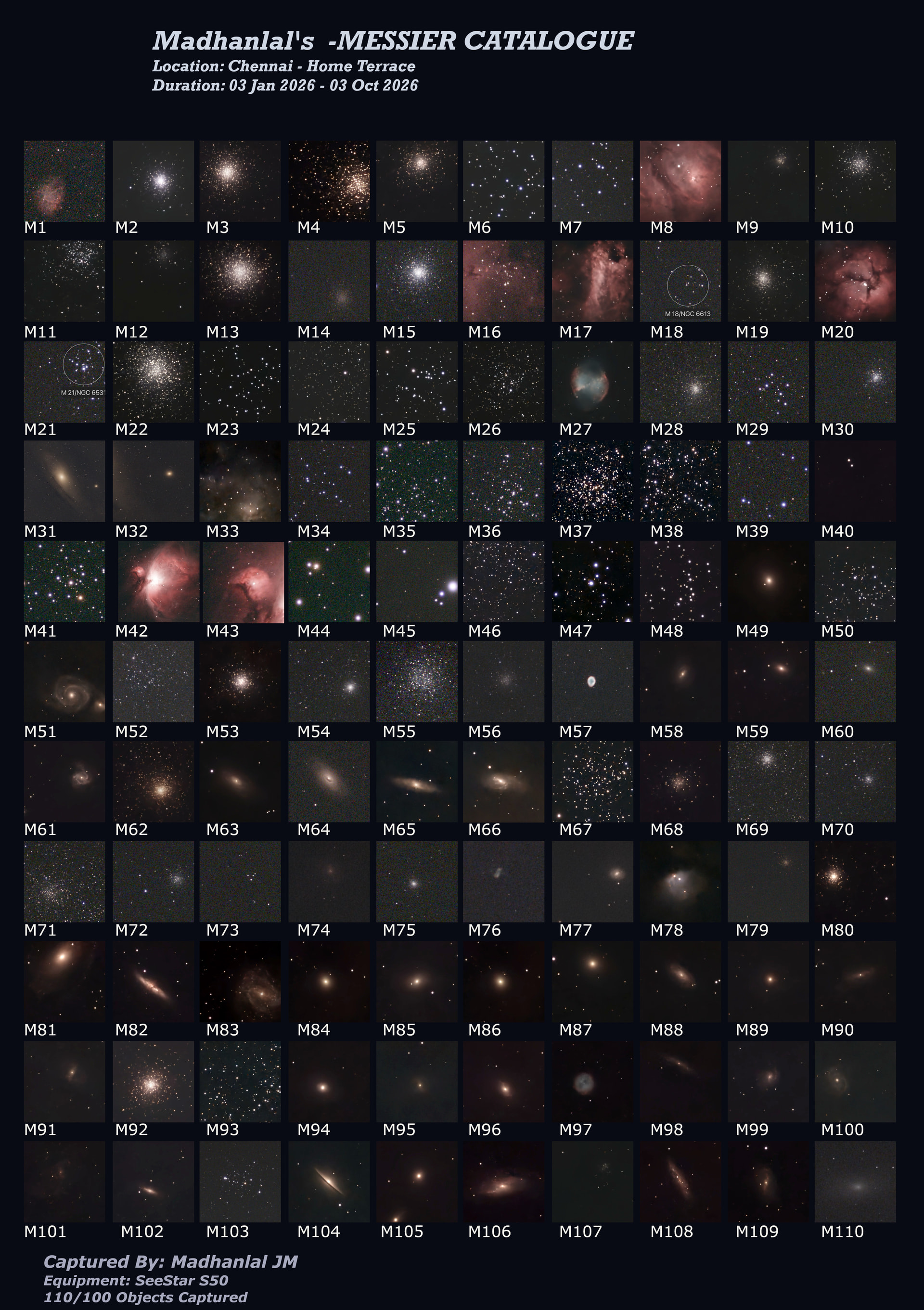
On 3rd October 2026, I completed one of my astronomy goals for this year, capturing all 110 objects of the Messier Catalogue.
I started the project on 3rd January 2026, and it took exactly nine months to complete.
The most satisfying part for me is that all 110 objects were captured from my home terrace in Chennai, under Bortle 8-9 skies, using a Seestar S50 with its stock Alt/Az mount.
What is the Messier Catalogue?
For those who are not familiar with it, the Messier Catalogue is a collection of 110 deep-sky objects, compiled by French astronomer Charles Messier.
It contains galaxies, nebulae, planetary nebulae, open clusters and globular clusters. Today, observing or imaging all 110 objects has become an interesting challenge for amateur astronomers.
My Setup
I kept the setup simple throughout the project:
| Item | Setup |
|---|---|
| Equipment | Seestar S50 |
| Mount | Stock Alt/Az |
| Location | Home Terrace, Chennai |
| Sky | Bortle 8-9 |
| Individual Exposure | 10 Seconds |
| Total Integration | Varies for different objects |
| Stacking | Seestar stock app |
| External Stacking Software | None |
| Catalogue Design | GIMP |
| Project Duration | 03 Jan 2026 to 03 Oct 2026 |
My main goal was to capture and identify all 110 objects, rather than trying to get a perfect photograph of every object.
The Journey
The most productive night was 21st June, where I managed to capture around 10 Messier objects in a single night, including M17, M19, M20, M21, M22, M23, M24, M25, M26 and M27
Integration time depended on the type of target.
Star clusters generally needed around 30 minutes, while nebulae and galaxies were usually given around 1-2 hours, depending on the sky and available time.
Star clusters were generally easier from my location. Faint and low-surface-brightness galaxies were much more difficult under Chennai’s Bortle 8-9 sky.
On the difficult side, objects such as M74, M110 and M76 did not give me expected results. But I could clearly identify the objects, so I counted them as completed. Better versions can always come later.
The Biggest Challenge is - Limited Horizon from my Home Terrace.
The nearby houses block approximately 30 degrees of sky towards the northern and eastern side. Because of this, I could not start imaging as soon as it rise above the horizon. I had to wait until the target climbed above the obstruction and became visible.
This required careful planning for every observing session. Before each night, I had to identify which Messier object would be available above 30 degree and prioritize them based on their visibility window.
For the final few objects, this planning became every more important, as I had to balance object visibility, moonlight, weather available from my location.
Toward the end of the challenge, I stopped waiting for perfect nights. If I got even a small clear-sky window and one of my pending objects was available, I used it.
A few of the final objects were completed exactly this way.
As usual Chennai weather and clouds are always unpredictable 
Some images are good. Some are average. Some definitely need another attempt.
But that is also what makes this catalogue interesting to me. Every image represents an actual observing session from my home terrace.
What I Learnt
The biggest lesson for me was not to wait for perfect conditions.
In astrophotography, especially from Chennai (bortle 8-9 skies), sometimes it is better to use whatever clear window is available.
I also learnt not to chase perfection while doing a catalogue challenge. First capture the object, identify it and complete the challenge. There is always time to revisit it and make the image better.
What’s Next?
The next step is to improve my post-processing skills and start revisiting some of the targets where I was not satisfied with the result.
I have also started experimenting with an equatorial setup for the Seestar S50, which will be another learning journey.
The first goal was to complete all 110.
Now it is time to follow a quote that I really like:
“First do it and then do it better.”