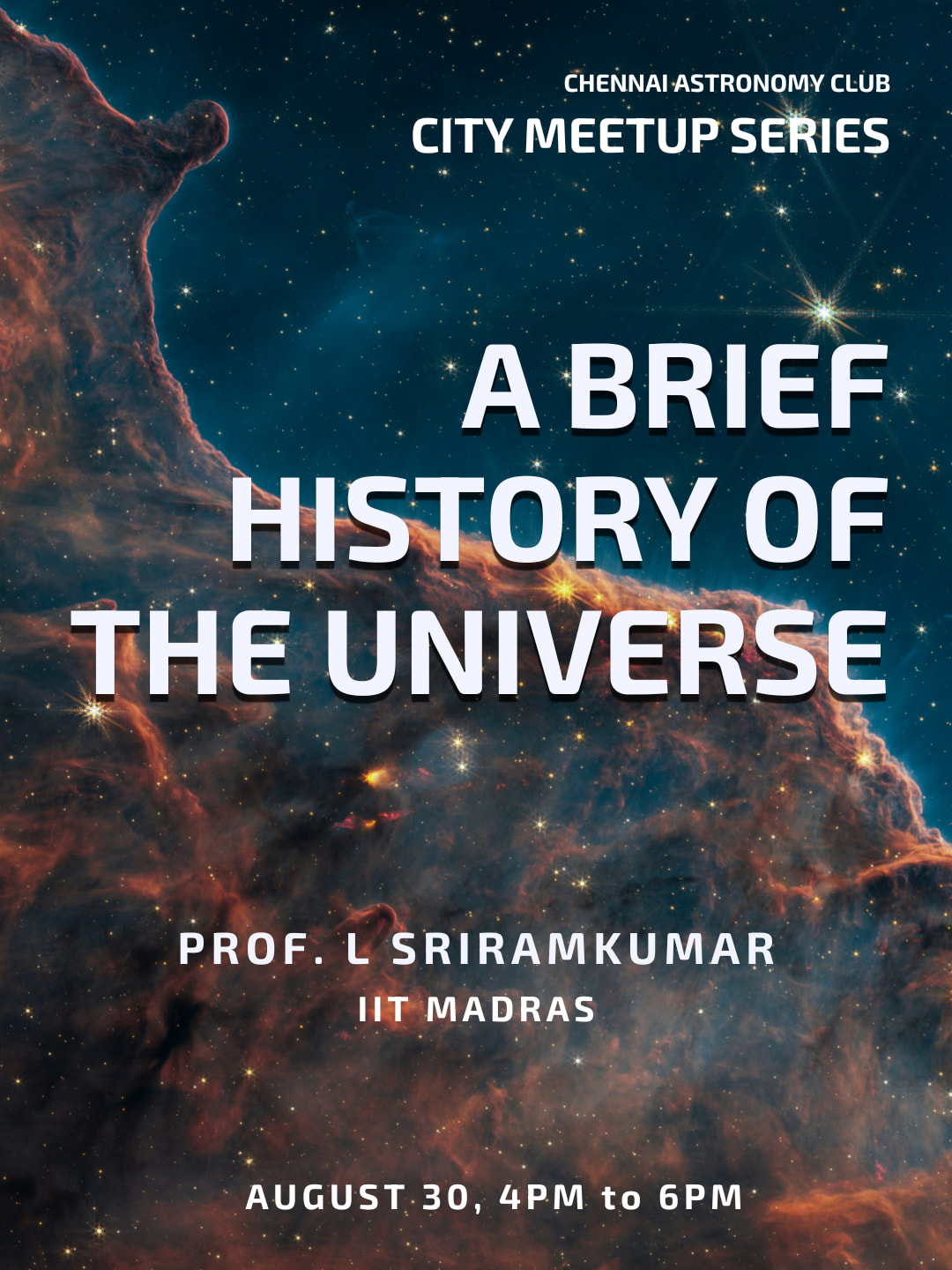
A Brief History of the Universe - Meet up Summary
A lecture by Prof. L. Sriramkumar
Introduction
The Universe we see today — filled with galaxies, stars, planets and life — has not always looked this way. It has evolved over an enormous span of time.
Modern cosmology tries to reconstruct this history using observations of distant galaxies, their light, the Cosmic Microwave Background (CMB), the distribution of galaxies, and the expansion of the Universe.
One of the most important ideas is:
Looking farther into space means looking further back in time.
Light takes time to travel. When we observe a distant galaxy, we are seeing it as it was when the light left that galaxy.
1. The Universe Is Expanding
The Universe is not static. The distances between sufficiently distant galaxies increase with time.
A useful way to imagine this is a grid that is being stretched. If galaxies are attached to different points on the grid, stretching the grid increases the distance between them.
The galaxies do not have to be imagined as moving through a pre-existing empty space. Instead, the geometry of space itself changes with time.
This expansion is described using Einstein’s theory of General Relativity.
2. Why Does Distant Light Become Red?
Light travelling through an expanding Universe experiences a stretching of its wavelength.
As the wavelength becomes longer, the light shifts towards the red end of the spectrum. This is called cosmological redshift.
In simple terms:
Expansion of the Universe → stretching of wavelength → redshift
This redshift is one of the important observations supporting the expansion of the Universe.
It is important to distinguish this from the ordinary Doppler effect. Cosmological redshift is fundamentally associated with the expansion of spacetime.
3. Looking Into the Past
Light travels at a finite speed.
Therefore, when we observe something far away, we are seeing it as it existed in the past.
For example, light from an object one million light-years away has taken approximately one million years to reach us.
So astronomy gives us something extraordinary:
Distance acts as a window into cosmic history.
The farther away we can observe, the earlier in the Universe we can see.
4. The Cosmic Microwave Background
Apart from the light coming from stars and galaxies, the Universe is filled with another form of radiation.
When astronomers measure the electromagnetic radiation coming from the sky, they find a component that peaks in the microwave region.
Its spectrum is remarkably close to that of a blackbody, indicating that it is thermal radiation.
This radiation is called the:
Cosmic Microwave Background — CMB
Today, the CMB has an average temperature of approximately 2.7 K.
It comes from essentially every direction in the sky.
This is strong evidence that it is not radiation from one particular galaxy or collection of stars. Instead, it is a relic of the early Universe.
5. Why Couldn’t Light Travel Freely in the Early Universe?
The early Universe was extremely hot and dense.
It contained large numbers of:
- Protons
- Neutrons
- Electrons
- Photons
At this stage, electrons were not bound into neutral atoms.
Free electrons interact strongly with photons, so photons were repeatedly scattered.
As a result, the early Universe was effectively opaque to light.
As the Universe expanded, it cooled.
Eventually, electrons combined with atomic nuclei to form neutral atoms, mainly hydrogen.
Once most electrons were bound into atoms, photons could travel much more freely.
These photons are what we observe today as the Cosmic Microwave Background.
6. The Last Scattering Surface
The epoch when photons last interacted significantly with matter is called the last scattering epoch.
The collection of locations from which those photons last scattered is called the last scattering surface.
This is not a physical spherical wall surrounding us.
It appears spherical because we observe ancient photons arriving from every direction.
The CMB therefore gives us a remarkably early snapshot of the Universe — from roughly 380,000 years after the beginning of the hot expanding phase.
7. The Universe Is Almost Perfectly Uniform
One of the remarkable features of the CMB is how uniform it is.
If we measure its temperature in different directions, the average temperature is almost identical everywhere.
This property is called isotropy.
However, when measurements become extremely precise, tiny differences appear.
These are called anisotropies.
This creates two fundamental questions:
Why is the Universe so uniform?
and
Why are there tiny variations at all?
The second question is particularly important because these tiny variations are believed to be the seeds from which the structures of the Universe eventually developed.
8. Tiny Fluctuations in the Early Universe
The early Universe was not perfectly smooth.
There were tiny fluctuations in its density and energy.
A simple analogy is a perfectly calm water surface. Drop a few stones into it and ripples appear.
Similarly, the early Universe contained tiny variations.
Modern cosmology connects these primordial fluctuations to processes in the very early Universe, potentially involving quantum fluctuations and inflation.
These fluctuations left an imprint on the CMB.
9. From Fluctuations to Galaxies
Why did these tiny fluctuations grow?
Gravity.
Suppose one region has slightly more matter than its surroundings.
That region has slightly stronger gravitational attraction.
It attracts more matter.
As more matter gathers, the gravitational attraction becomes stronger, causing still more matter to accumulate.
Over billions of years:
Tiny density differences
↓
Gravitational amplification
↓
Dense regions
↓
Stars and galaxies
↓
Clusters and cosmic web
Thus, the enormous structures we see today can trace their origins to extremely small irregularities in the early Universe.
10. The Cosmic Dark Ages
After the CMB was released, the Universe became transparent.
But there was another important problem:
There were no stars yet.
The Universe contained mostly neutral hydrogen and other matter, but no galaxies filled with shining stars like those we see today.
This period is known as the Cosmic Dark Ages.
Eventually, gravity caused dense regions of gas to collapse.
The first stars formed.
Their appearance marked the beginning of another major stage in cosmic history — the Cosmic Dawn.
11. The First Stars and Cosmic Dawn
The first stars formed from primordial gas collapsing under gravity.
These stars produced the first significant sources of starlight after the dark ages.
Their radiation also changed the surrounding Universe, contributing to the process known as reionization.
Over time, stars gathered into galaxies, and galaxies developed into increasingly complex structures.
12. The Cosmic Web
Galaxies are not distributed randomly.
They form an enormous network of:
- Galaxy groups
- Galaxy clusters
- Filaments
- Sheets
- Voids
This network is known as the cosmic web.
The Universe therefore has structure on many different scales.
A cluster can contain many galaxies, while enormous filaments can connect clusters across hundreds of millions of light-years.
13. Computer Simulations of the Universe
How can we test whether our theory of structure formation is correct?
One approach is to simulate the Universe using computers.
Imagine a huge three-dimensional box containing enormous numbers of particles.
Each particle experiences the gravitational influence of the others.
The computer calculates how the particles move and allows the system to evolve over cosmic time.
Initially, the distribution is relatively smooth.
Eventually, gravity creates dense regions, filaments and clusters.
These simulations can then be compared with the actual distribution of galaxies.
The Millennium Simulation is one famous example of such a large cosmological simulation.
The goal is not to reproduce every individual galaxy, but to see whether the large-scale statistical properties of the observed Universe emerge naturally from the assumed physics.
14. Why Does Radiation Stop Dominating?
The relative importance of radiation and matter changes as the Universe expands.
For ordinary matter:
\rho_m \propto \frac{1}{a^3}
For radiation:
\rho_r \propto \frac{1}{a^4}
where a is the scale factor of the Universe.
Radiation decreases faster because its energy is reduced not only by increasing volume but also by cosmological redshift.
Therefore, the Universe evolved through different dominant eras:
Radiation dominated Universe
Early Universe
↓
Matter dominated Universe
Formation and growth of large-scale structure
↓
Dark-energy dominated Universe
Present accelerated expansion
15. What Is the Universe Made Of?
One of the most surprising discoveries of modern cosmology is that the matter familiar to us represents only a small fraction of the Universe.
The approximate present-day composition is:
Component
Approximate fraction
 Ordinary matter
5%
 Dark matter
27%
Dark energy
68%
So the Universe is dominated by components whose fundamental nature is still not fully understood.
16. Dark Matter
Dark matter does not interact with light in the same way ordinary matter does.
Therefore, we cannot simply look at it and see it.
But we can detect its gravitational influence.
For example, the motion of galaxies and the gravitational behaviour of large structures reveal the presence of much more matter than we can see directly.
Dark matter is also extremely important in structure formation.
Its gravitational attraction helps create the framework within which ordinary matter can gather and form galaxies.
17. Dark Energy
The Universe is not only expanding.
Its expansion is currently accelerating.
The component associated with this accelerated expansion is called dark energy.
Dark energy is different from ordinary matter and radiation.
Its physical nature remains one of the biggest unsolved problems in cosmology.
We know that something is affecting the expansion history of the Universe, but we do not yet have a complete understanding of what that something fundamentally is.
18. Inflation and the Very Early Universe
The standard picture of cosmic history includes a very early period of extremely rapid expansion known as inflation.
Inflation provides a possible explanation for several important properties of the Universe, including its remarkable large-scale uniformity.
It also provides a mechanism by which extremely small fluctuations could have been stretched to enormous cosmic scales.
Those fluctuations could later become the seeds of galaxies.
However, an important distinction must be made:
We do not yet know what happened at the ultimate beginning.
The term Big Bang describes the early hot, dense, expanding state of the Universe. It is not, by itself, a complete explanation of what caused the Universe to begin.
19. Quantum Physics and the Origin of Structure
One of the deepest ideas in modern cosmology is the possible connection between quantum physics and the largest structures in the Universe.
The proposed chain is:
Quantum fluctuations
↓
Inflation
↓
Cosmic-scale fluctuations
↓
CMB temperature variations
↓
Gravitational growth
↓
Galaxies
↓
Stars, planets and eventually life
In this sense, the structures we observe today may carry an imprint of physics operating at an incredibly early stage of cosmic history.
20. How Do Astronomers Measure Cosmic Distances?
During the Q&A, Prof. Sriramkumar explains how astronomers determine distances to increasingly distant objects.
There is no single method that works for every distance.
Instead, astronomers build a cosmic distance ladder.
Parallax
For relatively nearby stars, astronomers use geometry.
As Earth moves around the Sun, a nearby star appears to shift slightly relative to more distant background stars.
Knowing Earth’s orbital baseline allows the distance to be calculated.
Cepheid Variables
For more distant objects, astronomers can use Cepheid variable stars.
Their pulsation period is related to their intrinsic brightness.
Therefore:
Measure period → determine true brightness → compare with observed brightness → calculate distance
Supernovae
At still greater distances, extremely bright supernovae can be used.
Type Ia supernovae are particularly useful because their intrinsic brightness can be calibrated.
These different methods overlap to create the cosmic distance ladder.
21. Supernovae and the Accelerating Universe
Distant supernovae provided crucial evidence that the expansion of the Universe is accelerating.
Instead of the expansion simply slowing down because of gravity, observations showed evidence for an accelerating expansion.
This led to the modern concept of dark energy.
It is an excellent example of how observations of extremely distant objects can reveal something fundamental about the entire Universe.
22. The Horizon Problem
The remarkable uniformity of the CMB raises another question.
How did enormously distant regions of the Universe end up with almost the same temperature?
In a simple picture without inflation, some of these regions would not have had enough time to communicate with each other.
This is called the horizon problem.
Inflation offers a possible solution.
Regions that were once much closer together could have been rapidly separated by the enormous expansion of space.
23. What Is the Universe Expanding Into?
A natural question is:
If the Universe is expanding, what is it expanding into?
The balloon analogy can help explain changing distances, but it should not be taken literally.
The Universe does not necessarily need to be imagined as an object sitting inside some larger empty space.
In cosmology, space itself is part of what is expanding.
The expansion is described through the changing geometry of spacetime.
24. The Standard Model of Cosmology
All these observations come together in what is commonly called the standard model of cosmology, often referred to as ΛCDM.
It combines:
- An expanding Universe
- A hot early Universe
- Primordial fluctuations
- Dark matter
- Ordinary matter
- Dark energy
- Growth of cosmic structure
- The Cosmic Microwave Background
The model successfully explains a remarkable range of observations.
But it should not be mistaken for a complete theory of everything.
There are still major unanswered questions.
25. What We Know — and What We Don’t
We understand reasonably well:
 The Universe is expanding
The Universe was much hotter and denser in the past
The CMB is relic radiation from the early Universe
The early Universe contained tiny fluctuations
Gravity amplified those fluctuations
Galaxies and clusters developed from those structures
Dark matter has important gravitational effects
The expansion of the Universe is currently accelerating
But major mysteries remain:
 What exactly happened at the beginning?
What is dark matter?
What is dark energy?
What caused inflation, if inflation occurred?
How exactly did the first stars and galaxies form?
These questions are the frontier of modern cosmology.
The Complete Cosmic Story
The story can be summarized as:
Very early Universe
↓
Inflation / extremely rapid expansion
↓
Primordial fluctuations
↓
Hot, dense Universe
↓
Radiation-dominated era
↓
Formation of atomic nuclei
↓
Atoms form
↓
CMB released
↓
Cosmic Dark Ages
↓
First stars
↓
Cosmic Dawn & reionization
↓
Galaxies form and grow
↓
Galaxy groups and clusters
↓
Cosmic web
↓
Dark-energy-dominated era
↓
Universe today
 Final Takeaway
The most powerful idea running through the lecture is that the Universe contains a record of its own history.
The light arriving from distant galaxies tells us about the past.
The Cosmic Microwave Background gives us a glimpse of the young Universe.
Tiny fluctuations in the CMB reveal the seeds from which galaxies eventually grew.
Gravity transformed those tiny irregularities into stars, galaxies, clusters and the cosmic web.
Observations of distant supernovae reveal the expansion history of the Universe.
And the behaviour of galaxies and large-scale structures reveals the presence of dark matter, while accelerated expansion points towards dark energy.
So the story of the Universe is not simply:
“The Universe began with the Big Bang and everything happened afterwards.”
It is a much richer story:
Tiny fluctuations in the early Universe grew through gravity into the enormous structures we see today — while the Universe itself continued expanding and evolving.
And perhaps the most fascinating part is that we can reconstruct much of this history billions of years later by studying the light that reaches us today.